

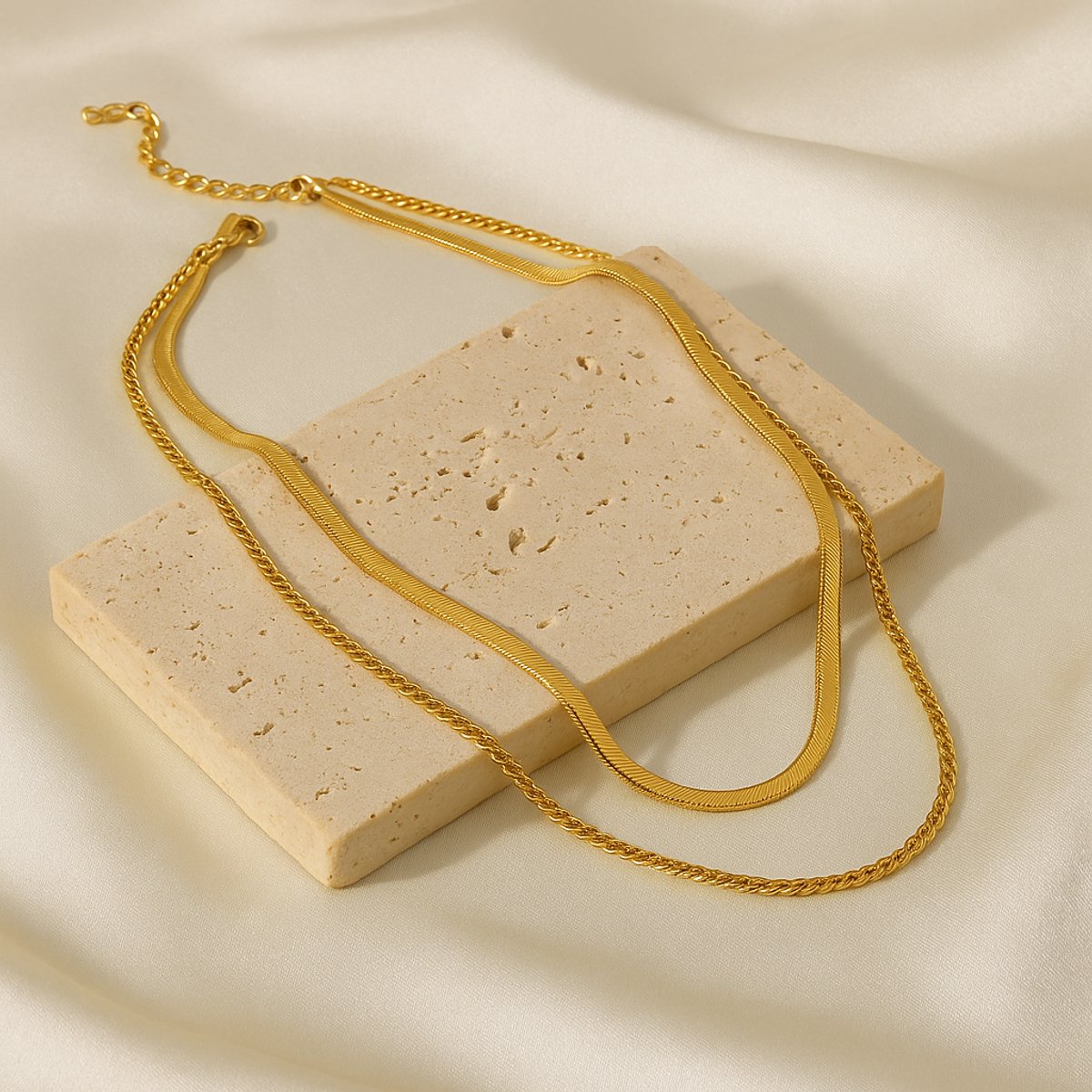

Which Jewelry Material Doesn't Tarnish? Complete Overview
Nothing is more annoying than a piece of jewelry that turns black after a few weeks, goes green or loses its golden shine. Which brings us to the big question: which jewelry material doesn't tarnish? In this guide we explain material by material what is and is not color-fast, why jewelry tarnishes in the first place, and what to look for when you want a piece that still looks beautiful years from now.
Our waterproof jewelry
All Lundholm jewelry is made from premium stainless steel with 2.5 micron PVD plating — waterproof, hypoallergenic and color-fast.


Which materials don't tarnish? (overview)
Before we go through each material separately, here is a quick overview. By "does not tarnish" we mean: it does not turn black, it does not leave green or black marks on your skin, and it keeps its color through daily wear, water and perspiration.
| Material | Doesn't tarnish? |
|---|---|
| Stainless steel (incl. surgical steel) | Yes ✓ |
| Stainless steel with PVD coating | Yes ✓ |
| Titanium | Yes ✓ |
| Platinum | Yes ✓ |
| Solid gold (14k / 18k) | Yes ✓ (the higher the karat, the more stable) |
| Real silver (925 sterling) | No — tarnishes (goes dark) |
| Gold-plated (thin layer) | Limited — the layer can wear off |
| Gold filled | Lasts a long time, but not indefinitely |
| Copper, brass, bronze | No — discolors and rubs off on the skin |
Why does jewelry tarnish in the first place?
Tarnishing is almost always a form of oxidation: the metal reacts with substances from the air or from your skin. With silver, the metal reacts with sulfur compounds in the air (and in perspiration) to form silver sulfide — that dark, sometimes black film you will recognize. With copper and brass a green layer forms (copper carbonate), which can also rub off on your skin.
A few factors speed this process up: perspiration (salt and acids), cosmetics such as perfume, cream and hairspray, chlorine and salt water, and even humidity. The more noble and stable the metal, the less it reacts to those influences — and that is precisely where the difference lies between a piece that tarnishes and one that stays color-fast. Also read our article why is my necklace discoloring? for all the causes lined up.
Stainless steel — the winner for everyday wear
Stainless steel, also known as surgical steel, is by far the most practical choice for jewelry. It contains chromium, which forms an invisible protective layer on the surface so the metal does not rust and does not tarnish. Good jewelry grades (such as 316L) are also hypoallergenic and low in nickel — nickel release stays well below the European limit — so they suit sensitive skin.
The big advantage: stainless steel stays color-fast through showering, washing your hands, swimming and working out. In principle you never have to take it off. Give it a gold-tone or silver-tone finish with a PVD coating (more on that below) and that color stays intact for years as well. That is why our entire Lundholm collection is made from premium stainless steel.
Titanium — light and skin-friendly
Titanium doesn't tarnish either and is extremely corrosion-resistant. It is also remarkably light and very hypoallergenic, which makes it popular for piercings and men's jewelry among other things. The downside: titanium is hard and difficult to work with, so fewer refined, feminine designs are made from it and it often costs more than stainless steel with comparable properties.
Platinum — long-lasting, but pricey
Platinum is a precious metal that naturally does not tarnish or discolor, and it is hypoallergenic as well. It is mainly used for wedding and engagement rings. The flip side is the price: platinum is among the most expensive precious metals, which makes it rarely a realistic option for fashion and gift jewelry.
Solid gold versus gold-plated — the key difference
This is where things go wrong most often in practice. Solid gold (14 karat or 18 karat) does not tarnish: it is a precious metal that does not oxidize. The higher the karat, the purer and more stable. But solid gold is expensive — a simple gold ring quickly runs into the hundreds of euros.
Gold-plated is something else entirely: a cheaper base metal with a thin layer of gold over it. If that layer is too thin or of poor quality, it wears away and the base metal underneath comes through — that is why cheap gold-plated jewelry starts to discolor. So the quality lies in the thickness of the layer and the base metal underneath. Our jewelry uses stainless steel as its base with 2.5 micron PVD gold plating: far thicker and harder than standard gold plating.
Real silver (925 sterling) — beautiful, but it tarnishes
Sterling silver (925) is a much-loved precious metal, but it does discolor: over time it darkens through the reaction with sulfur in the air and in perspiration. That is not a sign of poor quality — it simply comes with silver — but it does mean you have to polish it regularly with a silver cloth to bring the shine back. If you want the silver-tone look without the polishing, silver-tone stainless steel is the better choice.
Gold plated, gold filled and PVD — what is the difference?
These terms are often used interchangeably, while they say a great deal about how color-fast a piece of jewelry is:
Gold plated: a thin layer of gold on a base metal, applied by electroplating. Cheap, but the layer can wear away — quality depends on the thickness of the layer (expressed in microns).
Gold filled: a thicker gold layer that is mechanically bonded to the core under pressure. It lasts much longer than standard gold plating, but it stays more expensive and ultimately does not last indefinitely either.
PVD coating: Physical Vapour Deposition. Here the color layer is "burned into" the metal at molecular level in a vacuum process. The result is far harder, more scratch-resistant and more durable than classic gold plating. That is exactly why our 2.5 micron PVD layer on stainless steel is so color-fast and waterproof.
Would you rather stop thinking about tarnishing?
Our entire collection is made from premium stainless steel with PVD — waterproof, hypoallergenic and color-fast.
Shop all jewelry →Why Lundholm chooses premium stainless steel with PVD
We deliberately make all our jewelry from premium stainless steel with 2.5 micron PVD gold or silver plating. That combines the best of both worlds: the look of gold-tone or silver-tone jewelry, with the practical certainty that you do not have to take it off in the shower, while swimming or during a workout.
In concrete terms that means: waterproof, hypoallergenic and low in nickel (nickel release stays well below the European limit, so it suits sensitive skin too) and color-fast — the color does not tarnish and does not wear away the way thin gold plating does. A piece you wear every day without giving it another thought.
Color-fast & waterproof — a selection from the collection


How do you spot color-fast jewelry when you buy?
Keep an eye on a few things when buying. Look in the product information for the terms stainless steel, 316L, titanium, PVD or solid gold (14k/18k) — those are the color-fast materials. With gold plating, the layer thickness in microns is a good indicator: the thicker, the more durable. Terms like "fashion metal", "alloy" or "gold plated" with no further specification often point to a thin, less durable layer.
An honest seller states the material and the finish as a matter of course. If nothing is listed and the answer stays vague when you ask, that is usually a sign that the piece probably is not color-fast.
Care: how to keep any piece looking good for longer
Even color-fast jewelry looks its best with a little care. Put jewelry on last — after perfume, cream and hair products — and take it off first. Wipe it clean now and then with a soft, dry cloth and store pieces separately so they do not scratch each other. For real silver there is one extra rule: store it airtight (in a zip-lock bag, for example) and polish it with a silver cloth as soon as it tarnishes. You will find more tips in our guide to hypoallergenic jewelry.
Frequently asked questions about jewelry that tarnishes
Which jewelry material doesn't tarnish?
Stainless steel (including surgical steel), titanium, platinum and solid gold (14k/18k) do not tarnish. Stainless steel with a PVD coating is the most practical and affordable color-fast choice for everyday wear. Real silver, thin gold plating, copper and brass do discolor or tarnish.
Does stainless steel tarnish?
No. Stainless steel contains chromium, which forms a protective layer so it does not rust and does not tarnish. It stays color-fast through showering, swimming and working out. A gold-tone or silver-tone PVD finish stays intact for years as well.
Why is my silver jewelry turning black?
Real silver (925 sterling) tarnishes through a reaction with sulfur compounds in the air and in perspiration, which forms silver sulfide — the dark film. That comes with silver and is not a quality defect. A silver cloth brings the shine back. If you would rather skip that, choose silver-tone stainless steel.
What is the difference between gold plating and PVD gold plating?
Standard gold plating is a thin layer of gold applied by electroplating and it can wear away. PVD (Physical Vapour Deposition) applies the color layer at molecular level in a vacuum process, which makes it far harder, more scratch-resistant and more durable. Our jewelry uses a 2.5 micron PVD layer on stainless steel.
Does gold plating always discolor?
Not necessarily, but thin gold plating on a cheap base metal can wear away so the base metal becomes visible. What decides it is the layer thickness (in microns) and the base metal underneath. Stainless steel with a thick PVD layer stays color-fast far longer than standard gold plating.
Which jewelry can I wear in the shower and in the pool?
Stainless steel with a PVD coating, titanium and platinum are waterproof and can come along into the shower and the pool. Do take care with chlorinated and salt water: rinse your jewelry with clean water afterwards. Real silver and thin gold plating are better taken off.
Is stainless steel the same as surgical steel?
Surgical steel is a specific, high-grade type of stainless steel (often 316L) that is low in nickel and hypoallergenic. It is used for medical instruments and piercings, which also makes it suitable for sensitive skin.
Is Lundholm jewelry color-fast?
Yes. All our jewelry is made from premium stainless steel with 2.5 micron PVD gold or silver plating: waterproof, hypoallergenic and color-fast. It does not tarnish and the color does not wear away the way thin gold plating does, so you can wear it every day.
Love, the Lundholm team
Share
