

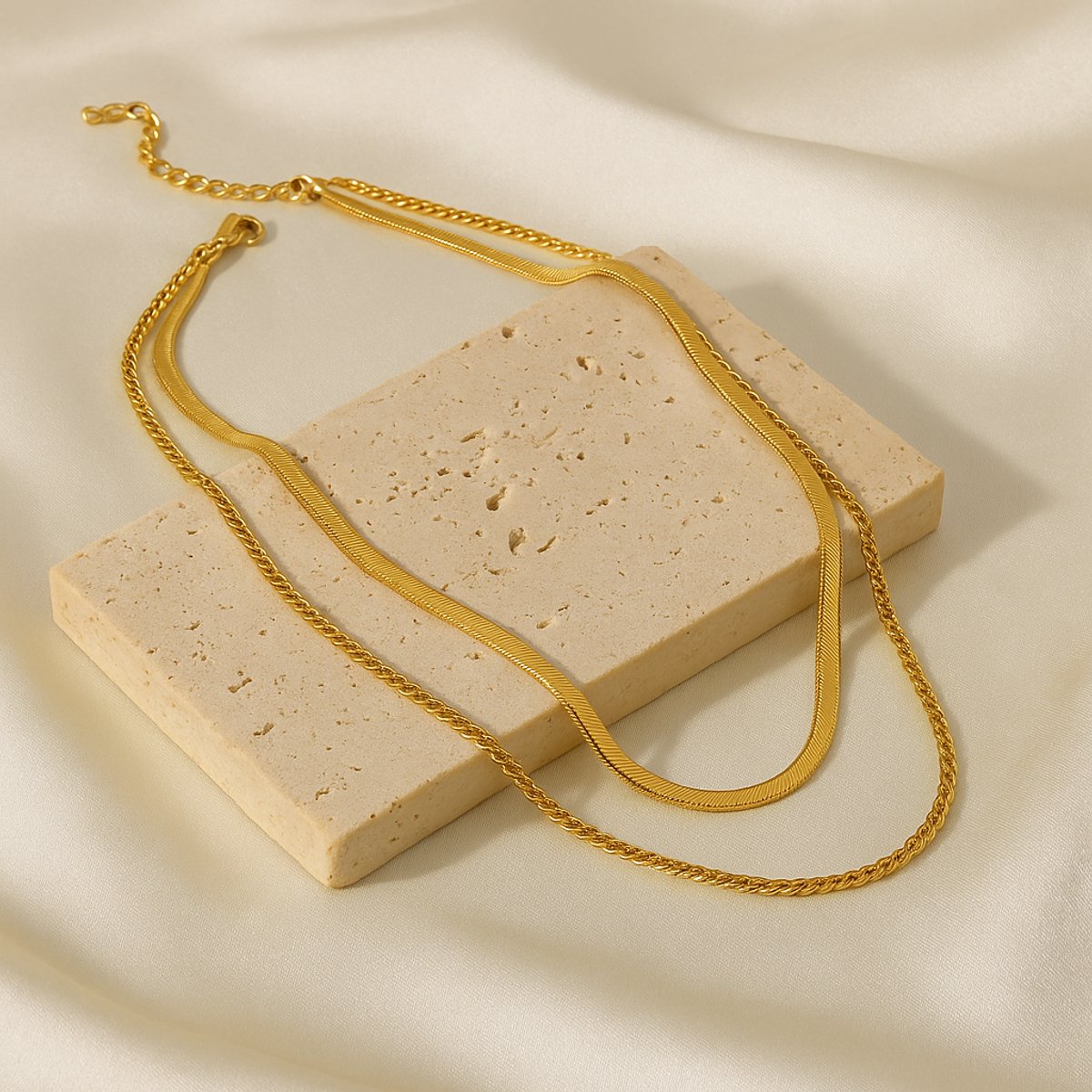

Why Does My Necklace Tarnish? The Causes and the Fixes

You open your jewelry box in the morning, reach for your favorite necklace, and you see it straight away: it has gone dull. Or worse — there is a green or black edge to it. Frustrating, because that was exactly the necklace you wore every day. In this article we explain why jewelry tarnishes, which materials keep their color the longest, and what you can do yourself to keep your jewelry looking good.
So why does my necklace tarnish?
Jewelry almost never tarnishes on its own. In nearly every case the metal is reacting to something around it — sweat, perfume, chlorinated water, body lotion. Cheap necklaces often have a thin layer of gold plating over another metal. As soon as that layer wears through, the metal underneath is exposed and reacts with your skin and the air.
Really cheap jewelry sometimes has nickel in the base alloy as well. That oxidizes faster and leaves that familiar green mark on your skin.


Which jewelry keeps its looks the longest?
Stainless steel — also known as surgical steel — is currently the smartest material if you want jewelry that holds its color year after year. It does not rust, it barely oxidizes and it does not react to sweat or salt water. That is why at Lundholm we work exclusively with premium stainless steel, and for the gold-tone versions a PVD layer of 2.5 microns.
A lot of mass-market jewelry gets a plating of only 0.1 to 0.5 microns. Our 2.5 microns is 5 to 25 times thicker than that.
Does Lundholm stainless steel tarnish too?
Honest answer: not with normal use. Our stainless steel jewelry is waterproof, hypoallergenic and made to be worn every day. It is one of the reasons our family (a mother and three daughters, all with a nickel allergy) started this brand in the first place.
With pieces that have stones or pearls, we do recommend not leaving them in water permanently.
Our best-loved necklaces
Timeless Scandinavian designs in premium stainless steel.
Shop all necklaces →How do you stop your jewelry from tarnishing?
Perfume, hairspray and body lotion always go on before your jewelry. Never spray directly onto your necklace.
Store every necklace separately. Piled on top of each other, they rub micro-scratches into the surface.
Wipe off sweat and sunscreen now and then with a soft damp cloth. No harsh cleaning products.
Chlorinated pools and saunas: take it off for a while. Chlorine in high concentrations can affect the PVD layer over time.
What if your necklace has already tarnished?
With stainless steel jewelry you can often bring the shine back with a microfiber cloth and lukewarm water. For darker tarnish, a jewelry polishing cloth (the soft yellow kind) does the job.
Necklaces that stay beautiful for years
Every one made from premium stainless steel with a 2.5 micron PVD layer.


Frequently asked questions about jewelry that tarnishes
How long does gold-plated stainless steel last?
With a PVD layer of 2.5 microns, the gold tone stays beautiful for years.
Can I shower with my stainless steel necklace?
Yes. Stainless steel is rustproof and handles daily contact with water perfectly well.
Why does a necklace turn my skin green or black?
That is caused by oxidation of the copper or nickel in the alloy.
What is the difference between stainless steel and 925 silver?
925 silver contains 92.5% silver and 7.5% other metals. That is why it oxidizes.
More favorites to discover
More pieces from our collection — varied in style and color.


Love, the Lundholm team
