


Filling an Advent Calendar: The German Tradition in 24 Gifts

Somewhere around the middle of November, 24 numbered pouches suddenly appear on a washing line in German living rooms. Not a chocolate calendar from the supermarket, but one filled by hand: 24 compartments someone has put together for her partner, her mother, her sister or her best friend. In Germany that is not one person's craft project — it is simply what you do.
Shop now: Gifts for her · Small gifts · Gifts under €50 · Gifts for him
They call it a befüllter Adventskalender, a filled Advent calendar: you buy an empty calendar — fabric pouches, little cardboard drawers, or 24 paper bags pegged to a length of string — and fill it yourself. In this article we introduce you to this German tradition: how to spread 24 compartments across a normal budget, what to do on the in-between days, and why in 2026 you need to start earlier than you think.
Why the Germans do this
The difference from the Netherlands, where Lundholm is based, lies in the calendar, not in the people. In the Netherlands December peaks on two evenings: Sinterklaas, the Dutch gift-giving celebration on 5 December, and Christmas Day. Not much happens in between. In Germany there is no Sinterklaas; Nikolaus on 6 December, when children leave out a boot to be filled overnight, goes no further than a few small treats; and the real presents are not opened until Heiligabend, Christmas Eve, on Thursday 24 December. Everything before that is the run-up, and in Germany that run-up is the actual celebration: the Advent wreath with one more candle lit every Sunday, the Christmas market, and 24 compartments you open for a moment each morning.
That is why a hand-filled calendar works so well as a gift. What makes it special is not what is in any one compartment, but the repetition: twenty-four mornings in a row, someone thinks of you. A single hundred-euro present does not do that. And unlike the chocolate version, this one is explicitly a gift for grown-ups — no toys, but small things she will genuinely use.
Sunday 29 November 2026: the date everything hinges on
The first Sunday of Advent falls on Sunday 29 November in 2026. The first candle is lit, and in most German homes the calendar is handed over that same weekend. The compartments are not opened until 1 December, but the calendar itself has to be there by then — filled and ready.
So count back from 29 November, not from 1 December. Within the EU our parcels take 3 to 7 working days; outside the EU, allow 5 to 14 working days. Order before 15:00 CET on a working day and we ship the same day. Allow for those seven working days and you are left with two deadlines: to have it in hand for the first Sunday of Advent, order by Wednesday 18 November at the latest, and to be able to open the first compartment on 1 December you have until Friday 20 November. Ordering from outside the EU? Then work back from fourteen working days and place your order by around Monday 9 November.
The days that stand out after that: the second Sunday of Advent on 6 December — in 2026 it coincides with Nikolaus, a lovely excuse for a double compartment — the third on 13 December, the fourth on 20 December, and Heiligabend on Thursday 24 December. We wrote about that sixth of December separately, in Nikolaus and Sinterklaas gifts for her. If you are running late anyway, our guide to last-minute Christmas gifts and delivery will help.
How do you spread 24 compartments across your budget?
This is where most people get stuck: 24 gifts sounds like a fortune. It only is if you spend the same amount 24 times over. German calendar-fillers work with a pyramid — we call it the 12-8-3-1 split:
12 compartments you fill almost for free: a chocolate, a tea bag, a bath pearl, a handwritten voucher (“good for one round of doing the dishes”). Budget € 2 per compartment, so € 24. 8 compartments get a small gift of € 8 to € 19 — delicate stud earrings, small hoops, a slim ring, a fine necklace — fourteen euros on average, so € 112. 3 compartments go bigger, € 20 to € 25: a ring, a necklace, a bracelet. Together € 69. And 1 compartment is the 24th, which is allowed to stand out: budget € 40.
All together: just under € 245. Want to keep it leaner? Move every amount down a rung — eight small pieces of jewelry at around nine euros, three pieces of jewelry at seventeen and a finale at twenty-five brings you to about € 170. Looking for more ideas in that middle bracket? Our list of Secret Santa gifts under 20 euros is good hunting ground. Jewelry ships worldwide for € 3.95, free from € 75 — a calendar order gets you over that on its own — and every piece comes in its own luxury Lundholm gift box.
The smallest compartments: little pieces she will actually wear
Half of your calendar is made up of things you do not think about for long. That is exactly where small jewelry is worth its weight in gold: flat enough for the smallest pouch, no size to guess, and something she genuinely wears afterwards. The Arina hoops with a heart are delicate enough for every day, the Kaya smiley studs bring a smile to a grey December morning, and the Emmy hoops are the simple pair that goes with everything.
And then there is the Jiva statement ring at € 6.95 — the least expensive piece of jewelry we sell, adjustable, gold-tone and big enough to be noticed. For a Tuesday halfway through December that is exactly right.
For the small compartments


The in-between days: a fine necklace, a delicate bracelet
Between the Sundays sit the ordinary days, and that is where the real craft is. Not too small, because then it feels stingy; not too big, because then your budget is empty by 10 December. The fifteen-to-twenty-euro zone is exactly right, and two kinds of jewelry fall into it that almost nobody thinks of as an Advent gift.
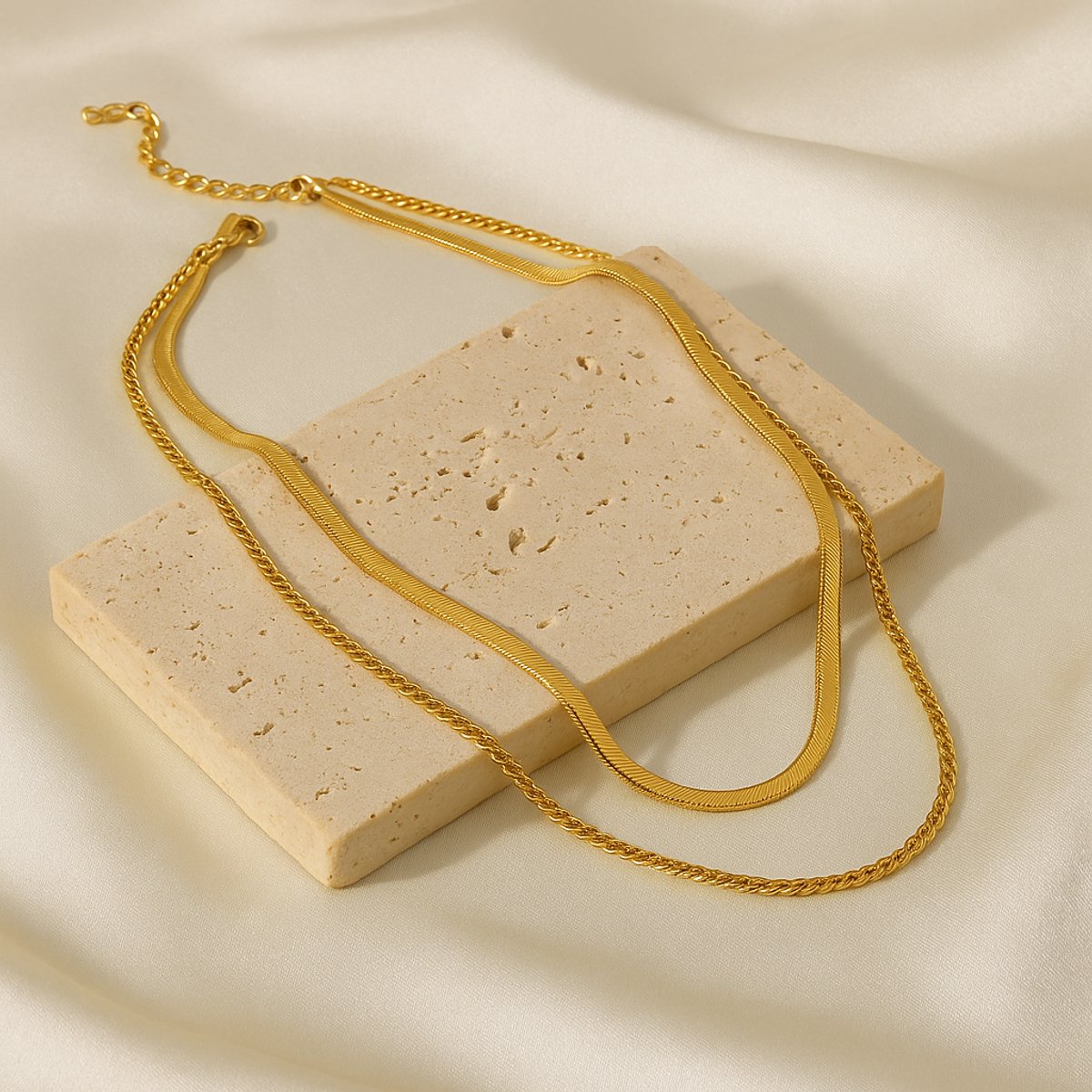
A fine necklace is one of them: there is no size to guess, it disappears under a jumper and reappears at the neckline of a blouse. The Tovi charm necklace with its little charms is the playful choice. You will find more under necklaces.
The second is the Tilda chain bracelet: fine enough to wear next to a watch, and the kind of thing she glances at every day. Put that one on a Monday — the day a calendar is needed most. Prefer to stay with earrings? The Nore knot studs or the Hayley studs work just as well on a weekday.
For the in-between days


Stud earrings: the safest gift in the whole calendar
If you had to pick one product group to fill an Advent calendar with, pick stud earrings. They are flat, so they fit in any compartment. They have no size. They come in every price bracket. And you can happily put three or four of them in the same calendar without it feeling like repetition — a pair of tulips on 4 December and a four-leaf clover on 17 December are two completely different gifts.
Ours start at € 14.95: the Fiene tulip studs, the Max ball studs and the Pia flower of life. A little above those sit the Klara four-leaf clover studs at € 19.95 and the Femme hearts at € 17.95. All of them premium stainless steel: hypoallergenic and waterproof, which makes them a good choice for most people with sensitive ears. You will find more choice in our stud earrings collection.

Our favorite stud earrings from € 14.95


Adjustable rings: no size needed, so no misses
A ring in an Advent calendar is a gamble, because the chance you know her ring size off the top of your head is small. There is a simple solution for that, and it is hugely popular in Germany: the adjustable ring. It is open at the back, you gently bend it a little wider or narrower, and that makes it fit almost any finger. No guessing needed, and no exchanging either.
The Elia minimalist ring at € 19.95 is the quietest of the bunch and goes with everything. The Milea wave ring at € 17.95 has a flowing play of lines that sits beautifully next to a ring she already wears. Slightly bolder are the Aveline open link ring at € 27.50 and the Idun ring with natural stone at € 27.95. That last one is a fine candidate for the third Sunday of Advent.
Adjustable rings — one size, always a hit


The 24th compartment: what it is all for
This is the difference between a nice calendar and a calendar she still remembers in five years. In Germany the Christmas presents are opened on Heiligabend — Christmas Eve, Thursday 24 December — so the last compartment lands exactly on the big moment. Germans deliberately put something in there that lifts the whole month: not the most expensive thing they can afford, but the gift with the most meaning.
In practice that means something for her neck or her finger, rather than yet another accessory. The Tove 3-layer layered necklace at € 39.95 is our clearest candidate — three layers in one necklace, so you can tell at a glance that this is the showpiece of the month. Want something quieter? Look at the Asta solitaire ring with cubic zirconia or the Rosan tiger's eye necklace, both € 34.95. If you are torn between types of jewelry, our article on a Christmas gift for your girlfriend will help.
For the 24th compartment


Practical: numbering, wrapping and holding the rhythm
Lay everything out on the table before you put anything into a pouch. That way you can see at a glance whether you have accidentally ended up with four pairs of studs and no necklaces. Then divide them up by a simple rhythm, the 1-6-12-18-24 rule: your best gifts on those five days, the little ones in between. Day 1 sets the tone, day 6 is Nikolaus, day 12 is halfway — exactly where most calendars start to drag — day 18 is the last Friday before Christmas, and day 24 is the grand finale.
Only number the pouches after you have filled them, otherwise you will spend the whole evening shuffling things around. And keep two compartments empty until last: something always turns up that makes you think “that is the one”.
Fill your calendar with jewelry she will actually wear
Waterproof, hypoallergenic stainless steel in Scandinavian design — every piece in a luxury gift box. Jewelry ships worldwide: € 3.95, free from € 75.
Shop all jewelryFrequently asked questions about filling an Advent calendar
When does an Advent calendar need to be ready?
Before the first Sunday of Advent, which in 2026 is Sunday 29 November. The compartments are not opened until 1 December, but in Germany the calendar is traditionally handed over during the first Advent weekend. Delivery within the EU takes 3 to 7 working days, so order by Wednesday 18 November at the latest. Outside the EU, allow 5 to 14 working days and order by around Monday 9 November.
What does it cost to fill an Advent calendar yourself?
With the 12-8-3-1 split you land at around € 245: twelve compartments almost free with small treats, eight compartments with a gift of € 8 to € 19, three at € 20 to € 25 and the 24th compartment at around € 40. A rung lower, a complete calendar is already doable for about € 170.
What do you put in an Advent calendar for a grown woman?
Small pieces she will genuinely wear: delicate stud earrings, small hoops, adjustable rings and, for the in-between days, a fine necklace or a delicate bracelet. Fill the rest with chocolate, tea and handwritten notes.
What do you do on the in-between days?
Keep those deliberately small: a chocolate, a note or a tea bag is enough. Put your good gifts on fixed peak days — 1, 6, 12, 18 and 24 — so there is rhythm to it and your budget is not gone halfway through.
What do you put in the 24th?
The finest gift of the whole calendar. In Germany the Christmas presents are opened on Heiligabend, Christmas Eve, 24 December, so the last compartment coincides with the big moment. A necklace or a ring works best there, for example a 3-layer layered necklace at € 39.95. Make that pouch physically bigger than the rest too.
Can you give a ring without knowing the ring size?
Yes, with an adjustable ring. It is open at the back and you gently bend it wider or narrower, so it fits almost any finger. That makes it one of the safest pieces of jewelry to put in an Advent calendar.
An Advent calendar you fill yourself costs you one evening at the kitchen table and gives back twenty-four mornings. Start with the peak days, top up the rest with small things, and make sure your order is placed by 18 November (by around 9 November if you live outside the EU). Browse all jewelry and start filling your first compartments.
