




What Is Baargoud? The Dutch Birth Gift for the Mother, Explained
Baargoud is the Dutch birth gift for the mother: a piece of jewelry she receives after giving birth, usually from her partner. The word combines 'baren', a formal Dutch verb for giving birth (related to the English 'to bear' a child), with 'goud', gold. Most often it is a delicate necklace, ring or bracelet with a heart, the baby's initial or birthstone: something she wears every day, as a reminder of the day her child was born.


The short answer
Baargoud (say it roughly like "BAHR-khowt", with the throaty Dutch g) is the Dutch word for a piece of jewelry the mother receives after giving birth.
- Meaning: baren (to give birth) + goud (gold). It is not a type of gold, but a gift.
- Who gives it: usually the partner; sometimes her parents, a sister or best friend, or the mother herself.
- When: often in the first days or weeks after the birth, but there is no fixed rule.
- Which piece: a necklace is the classic; a ring, bracelet or earrings work just as well.
- Make it personal: with the baby's initial, the birthstone of the birth month or a heart.
What does baargoud mean?
Baargoud is a gift, not a type of gold. The word is made up of 'baren', a formal Dutch verb for giving birth, and 'goud', gold. It goes to the mother, not the baby: a lasting piece of jewelry that honours what she has just done, and reminds her of her child's birth every day. If you live in the Netherlands, chances are you will hear the word around a birth, from Dutch friends, family or colleagues. The closest English equivalent is a push present.
Baargoud is also different from a regular baby gift. A baby gift (in Dutch: kraamcadeau) is usually for the baby or the family: tiny clothes, a cuddly toy, something practical. Baargoud is one personal piece of jewelry for the mother herself. Nor is it a pregnancy necklace: you wear that during pregnancy, while baargoud comes after. Read more in what is a bola pregnancy necklace.
Where does baargoud come from?
The word baargoud is Dutch, but sources disagree on where the custom itself comes from. Some call it an old Dutch tradition; others see it as the Dutch version of the British and American push present, which has become better known in the Netherlands in recent years. There are no solid historical sources for a fixed tradition, so we will stick to what we do know.
What we do know: celebrating a birth with a gift for the mother fits right in with other Dutch birth customs. Think of the kraamvisite, when family and friends come round to meet the newborn, and beschuit met muisjes: Dutch rusks topped with sugar-coated aniseed sprinkles in pink or blue, served to visitors after a birth. And it makes sense that the gift is a piece of jewelry. Like a wedding ring, she wears it every day, it lasts for years, and one day it may even be passed on to her child.
Who gives baargoud, and when?
Traditionally, the partner gives baargoud to the mother. But there is no fixed rule, and that is what makes it lovely. For a mother without a partner, it often comes from her parents, a sister or a best friend. In a family with two mothers, one gives it to the other. And more and more mothers buy themselves a piece as a keepsake of this time.
And when? Many people give it in the first days or weeks after the birth, at a quiet moment at home, just the two of you. In the middle of a busy round of visitors, that moment easily gets lost. Running a little late? It is still baargoud. Some people deliberately give it on the baby's first birthday, once that first year is behind them.

Pictured
Kerstin – a heart and a handwritten note
Add a handwritten card: why you chose this particular piece, or the date and time of the birth. Ten years from now, that card will be almost as precious as the jewelry itself. The Kerstin in the photo is a silver-tone paperclip necklace with a puffed heart.
View the Kerstin →Which piece of jewelry should you choose as baargoud?
The classic is a delicate gold necklace with a pendant, but a ring, bracelet or earrings work just as well. Above all, choose something that suits her. Look at what she already wears: is she never without a necklace, or does she love rings? With a baby around, small and close to the skin works best. This quick guide sums it up:
| Piece | Why | Tip with a baby around |
|---|---|---|
| Necklace | Close to the heart; the classic choice | A short chain with a small pendant |
| Ring | Always in sight, while feeding and changing too | Choose adjustable: her ring size may be a little different after pregnancy |
| Bracelet | Subtle; mostly she sees it | A fine, smooth chain is less likely to snag |
| Earrings | Small, light and always in | Studs rather than drops or large hoops |
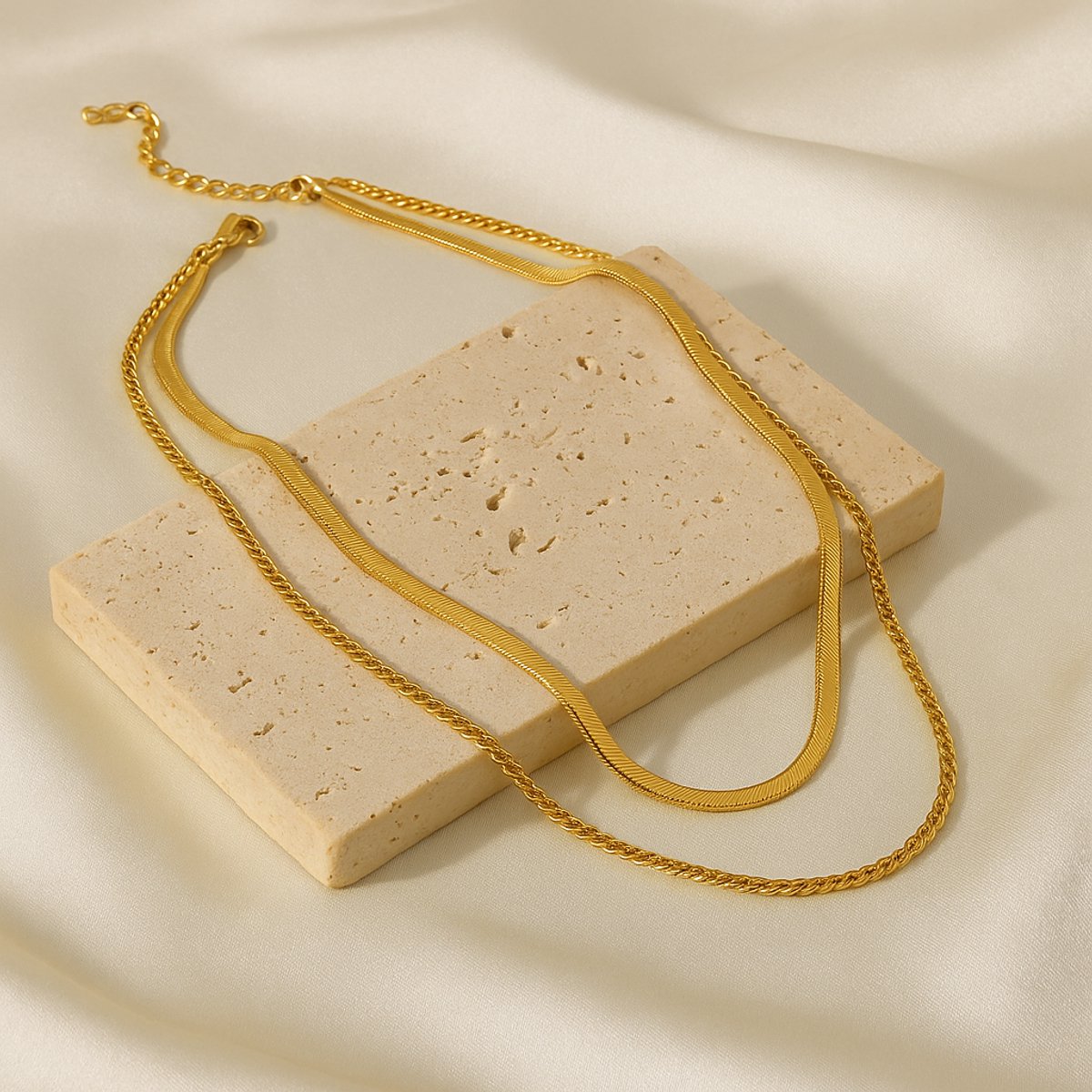
A baargoud necklace
A necklace is the most popular form of baargoud. She wears it close to her heart, and it goes with everything, from joggers in the first week to a dress on the first birthday. Three lovely directions: two linked hearts, one big and one small, for mother and child; a locket that holds a tiny photo of the baby; or a pendant in the colour of the birthstone. With a photo in the locket, take the necklace off in the shower so the photo stays nice.


A baargoud ring
A ring is something she sees all day: while feeding, changing, waving goodbye at the door. A ring with the baby's initial is personal without everyone instantly getting it. A ring in the colour of the birthstone becomes a story that can grow: with the next child, she simply adds another ring. To keep it classic, a solitaire like the Asta (in the opening photo) is timeless. All three are adjustable, which helps if you don't know her ring size. Not every letter of the initial ring is available, so check the product page first. Read more about letter rings in rings with a letter.


A baargoud bracelet
A bracelet is the most subtle kind of baargoud: she is the one who sees it, all day long. Linked hearts are a much-loved symbol here: two hearts that hold on to each other, for the bond between mother and child. Choose a fine, smooth chain so it won't snag on a onesie or muslin cloth.

Pictured
Alice – two intertwined hearts
Two hearts that hold on to each other, on a fine chain bracelet: a small symbol of a big bond. It comes in gold-tone and silver-tone; the photo shows both side by side.
View the Alice →

Baargoud earrings
Earrings as baargoud? Absolutely, as long as you choose studs. A baby grabs anything that sparkles or dangles, so save drops and large hoops for later. Small studs simply stay put. A pair of sparkling studs is a timeless choice; baby feet, a birthstone or a tree of life make them more personal.


Real gold, gold-plated or gold-tone?
As the name suggests, baargoud was originally a piece of real gold jewelry. Today you will see three options, and they are not the same:
Real gold. The whole piece is gold, for example 14 or 18 carat. The classic form, and the most expensive.
Gold-plated. Another metal, often silver, with a layer of gold on top.
Gold-tone stainless steel. Stainless steel with a gold-tone PVD coating. Not solid gold, but waterproof and hypoallergenic.
If the precious metal matters most, choose real gold. If it is about the gesture and a piece she truly wears every day, stainless steel is a great fit. All the jewelry in this article is made of premium stainless steel with a gold-tone or silver-tone PVD coating. It is waterproof, so she can shower and bath the baby without taking it off, and hypoallergenic, which is nice for sensitive skin.
Modern takes on baargoud
Baargoud no longer always looks the same. These are some of the variations you see a lot today:
- Silver instead of goldDoes she mostly wear silver? Then give it in silver, like the Kerstin. It is the gesture that counts.
- One piece per childAdd a ring with every child, so she builds her own stack.
- A locket with a photoA heart on the outside, that very first photo on the inside.
- For yourselfMore and more mothers buy their own baargoud as a keepsake of this time.
Baargoud for a second or third child
Can you give baargoud for the next child too? Of course. Choose something that goes with what she already has, so her jewelry tells one story together: a second birthstone ring to stack, or studs that match the necklace from the first. Or something completely different, so every child has a piece of its own. It is a gesture, not an obligation.
Shipping and gift wrapping
Order before 3 pm (CET) on a working day and we ship the same day. Free shipping thresholds depend on your country; you will find the details on our shipping page. Every piece is sent in a luxury gift box, and when you order from our own web shop you always get a free gift bag too: handy if you want to give the baargoud straight away. On larger orders, our gift ladder adds free gifts as well. For more ideas around the birth, read what to give someone who has just become a mother.
Frequently asked questions about baargoud
What is baargoud?
Baargoud is the Dutch birth gift for the mother: a piece of jewelry she receives after the birth of her child, usually from her partner. It is a lasting reminder of the birth. Often it is a necklace, ring or bracelet with a heart, the baby's initial or birthstone.
What does the word baargoud mean?
The word combines 'baren', a formal Dutch verb for giving birth, with 'goud', gold. So baargoud is not a type or carat of gold, but the name for a gift to the mother after the birth. The closest English term is a push present.
Where does baargoud come from?
The word is Dutch, but the exact origin of the custom is not clearly documented. Some call it an old Dutch tradition, others see it as the Dutch version of the English push present. Either way, it fits in with other Dutch birth customs, such as the kraamvisite and beschuit met muisjes.
Who gives baargoud?
Traditionally the partner. But it can also come from her parents, a sister, a best friend or the co-parent. More and more mothers also buy their own baargoud.
When do you give baargoud?
Usually in the first days or weeks after the birth, at a quiet moment at home. There is no fixed rule: giving it later is fine too, for example on the baby's first birthday.
Is a baargoud necklace, ring or bracelet best?
A necklace is the classic and the most popular choice. A ring is something she sees all day, and a bracelet is the most subtle. Above all, look at what she already wears. With a baby around, small works best: a short necklace with a small pendant, an adjustable ring, or studs rather than drops.
Does baargoud have to be real gold?
No. Baargoud was originally real gold, but it is the gesture that counts. Gold-tone stainless steel with a PVD coating is not solid gold, but it is waterproof and hypoallergenic, so she can wear it every day, even in the shower.
What is the difference between baargoud and a baby gift?
A baby gift (kraamcadeau) is usually for the baby or the family, such as clothes or something practical. Baargoud is one personal piece of jewelry for the mother herself.
Do you give baargoud for a second child too?
You can. Many people then choose something that goes with the first piece, such as a second birthstone ring to stack. It is not an obligation.
Looking for baargoud?
Discover delicate necklaces, rings and bracelets she will wear every day: waterproof, hypoallergenic and always in a luxury gift box.
