



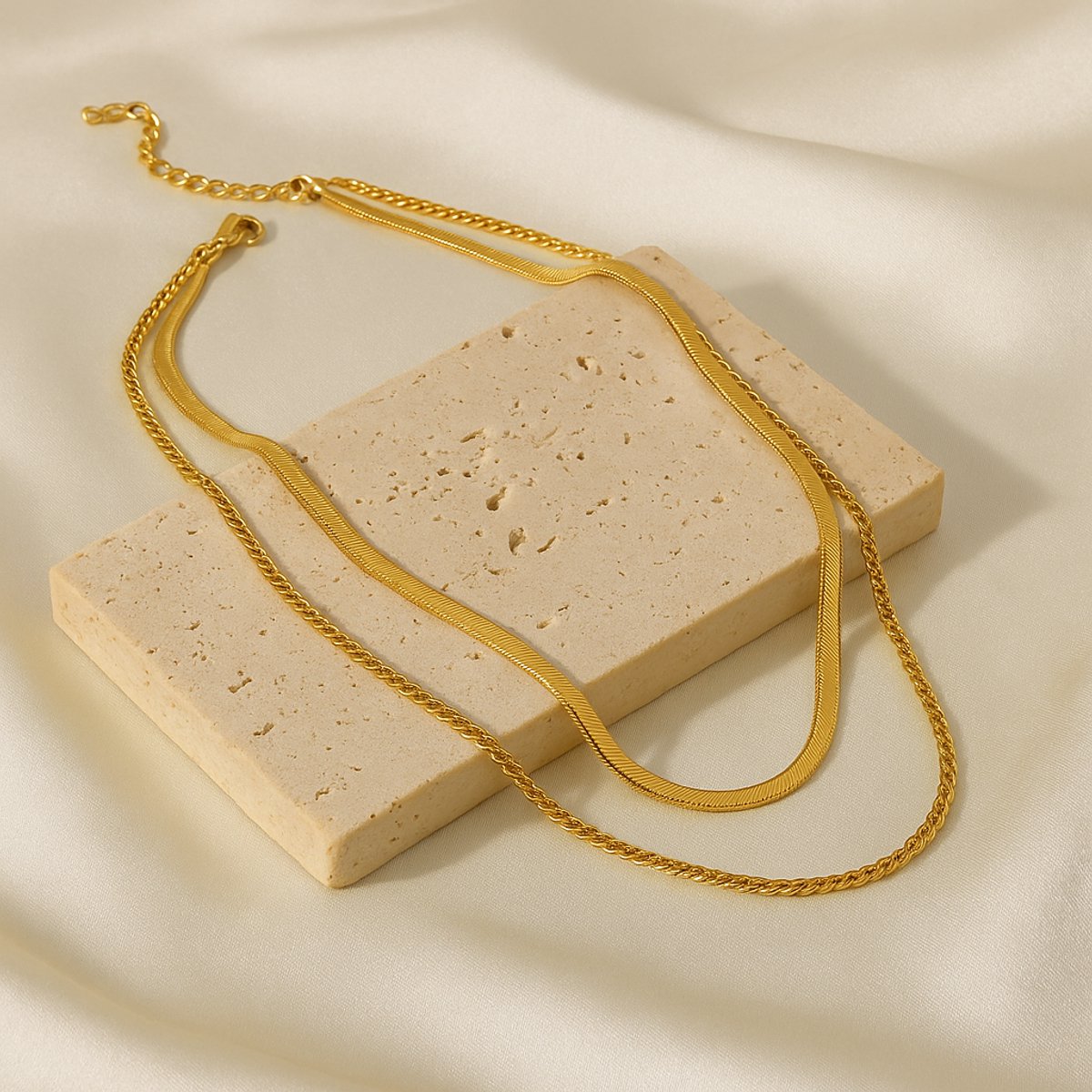

Why Does My Necklace Tarnish? The Causes and the Fixes
Why is my necklace tarnishing? In most cases the metal is reacting with something around you: sweat, perfume, body lotion, chlorine or sulfur in the air. Copper and brass turn dark or green, silver turns black, and on thinly gold-plated jewelry the gold layer wears away, after which the metal underneath starts to discolor. Below you'll find what happens with each material, what you can do about it and how to prevent it.


The short answer
Jewelry tarnishes because metal reacts with moisture, sweat, cosmetics and air. How fast that happens depends mainly on the material:
- Copper and brass: turn dark and can leave a green mark on your skin.
- Zinc and zinc alloy: go dull and gray as soon as the coating wears off.
- Gold-plated: the thin gold layer wears away and the metal underneath discolors.
- Sterling silver (925): turns black from sulfur in the air and on your skin.
- Stainless steel (surgical steel): barely tarnishes; dullness is usually a film of dirt or lotion.
- Stainless steel with PVD: a hard color layer that wears much more slowly than regular gold plating.
Already tarnished? Stainless steel and silver can often be brought back; with plated copper or zinc the color usually won't return.
Lundholm makes jewelry from premium stainless steel, with a PVD layer on the gold-tone pieces. Below we explain why that material behaves differently from copper, zinc or silver, and where stainless steel still needs a little care.
Why does jewelry tarnish?
Almost all discoloration comes down to three things:
- Oxidation. Metals like copper and zinc react with oxygen, moisture and the salts in your sweat. That creates a layer of oxide or copper salt: dark, dull or green.
- Sulfur. Silver reacts with sulfur compounds in the air, in rubber, wool and some cosmetics. This forms silver sulfide, which is black.
- A coating that wears off. Lots of jewelry is made of a cheaper metal with a thin layer of gold or silver on top. Where that layer wears through, at the clasp, the back of a pendant or the inside of a ring, the metal underneath is exposed and starts to discolor.
What speeds it up: sweat and skin acidity, perfume and hairspray, body lotion and sunscreen, chlorine from the pool or cleaning products, salty seawater and a humid bathroom. That's why the same necklace tarnishes faster on one person than on another.
Which jewelry tarnishes? An overview by material
At a glance: what you see with each material, and what causes it.
| Material | What you see | Cause |
|---|---|---|
| Copper and brass | A dark haze, green spots, a green mark on your skin | Copper reacts with sweat, moisture and air |
| Zinc and zinc alloy | Dull, gray or dark once the coating wears | The zinc underneath oxidizes |
| Gold-plated brass or zinc | The gold color wears away, dark or green underneath | A thin layer over a metal that does react |
| Gold-plated silver (vermeil) | Spots where the gold is gone and the silver darkens | The gold wears, the silver reacts with sulfur |
| Sterling silver (925) | First yellow, then brown, finally black | Sulfur from air, skin and cosmetics |
| Stainless steel (surgical steel) | At most dull from a film of dirt or lotion | Chromium forms a protective layer |
| Stainless steel with PVD | The color layer wears slowly; underneath is steel, not copper | A hard layer that bonds strongly to the steel |
And gold? Solid gold barely tarnishes. Only lower-karat gold, such as 9k or 14k, can develop a light haze over time because of the other metals in the alloy.
Copper and brass: why does my bracelet turn my skin green?
That green ring around your wrist or finger almost always comes from copper. Brass and bronze are alloys with lots of copper, and there's copper under the coating of many cheap gold-plated pieces too. Copper reacts with the salts and acids in your sweat, creating green copper salts that stay behind on your skin. The more moisture on your skin, the faster it happens, which is why it's often worse in summer or when you work out.
The good news: that green mark is usually harmless and washes off with soap and water. A bracelet made of untreated copper or brass can be polished. If it has a plated layer, the green only gets worse as that layer wears further.

Pictured
Tammy and Brianna – stainless steel on your wrist
Two gold-tone bracelets made of stainless steel with a PVD layer: the open bangle Tammy and the double Brianna, both with a knot. Stainless steel isn't a copper alloy, so the green mark you know from copper doesn't form.
View the Tammy →

Find more in our bracelets; read how to combine them in how to stack bracelets.
Zinc and zinc alloy: why does it go dull and gray?
Zinc alloy, often called zamak (zinc with a little aluminum, magnesium and copper), is widely used for cheap fashion jewelry because it's easy to cast into shapes. The metal is soft, so it's almost always coated with a thin gold- or silver-tone layer, often over an underlayer of nickel.
As long as that coating is intact, you see nothing. Once it wears, the zinc oxidizes: it turns dull, gray or dark, sometimes with green spots from the copper in the alloy. Searching for 'tarnished zinc alloy jewelry'? This is what you're seeing. Unfortunately it can't be restored: polishing only removes more of the coating, and re-plating is rarely worth it.
Sterling silver and gold-plated silver: why does silver turn black?
Sterling silver (925)
Sterling silver (925) is 92.5 percent silver; the rest is other metals, usually copper. Silver reacts with sulfur compounds that are all around us: in the air, in sweat, in rubber, wool, eggs and some creams. That creates silver sulfide, a layer that turns yellow first, then brown and finally black. It isn't dirt and it isn't a sign of poor quality: it's simply how silver behaves. In a humid bathroom or an open dish it happens faster than in a closed pouch.
Gold-plated silver
Gold-plated silver (vermeil) is silver with a layer of gold. That layer also wears in the places that rub the most. There the silver comes through, and it can then turn black. The result is a necklace that's still gold-colored in some places and dark in others.

Pictured
Kerstin – silver-tone stainless steel
Love the cool shine of silver, but not the polishing? Silver-tone stainless steel contains no silver, so the black silver-sulfide tarnish doesn't form. The Kerstin is a paperclip necklace with a shiny puffed heart.
View the Kerstin →


Find more in our silver-tone necklaces. Torn between gold and silver? Read gold or silver: which suits me better?
Stainless steel and surgical steel: do they tarnish?
Stainless steel is an alloy of iron with at least 10.5 percent chromium. That chromium forms an invisible, ultra-thin layer of chromium oxide on the surface that protects the metal and repairs itself after a scratch. That's why it doesn't rust and barely reacts with sweat, water or air. 'Surgical steel' is an umbrella name for skin-friendly grades, usually 316L; 304 is another widely used stainless grade.
So can stainless steel never discolor? It can, a little. Dullness usually comes from a film of soap, lotion, perfume or skin oil, which simply washes off. Harsh products like chlorine bleach can leave spots, and very cheap steel with little chromium can develop rust specks. So the quality of the steel does matter.
Gold-tone stainless steel that looks tarnished: what's going on?
Gold-tone stainless steel is steel with a gold-colored layer on top. If it looks darker or duller, it's usually a film of cosmetics or sweat: with lukewarm water and mild soap it's often bright again. If you see silver-gray steel showing through at friction points, the color layer has worn there. It won't turn green, because underneath is steel, not copper. How long a color layer lasts depends mostly on how it was applied.


PVD: why does it tarnish more slowly than gold-plated brass?
With regular (electroplated) gold plating, a piece of jewelry hangs in a bath in which a thin layer of gold settles onto the metal. On cheap jewelry that layer is often wafer-thin and sits on brass or zinc. With PVD, physical vapor deposition, the color layer is applied to the steel as a vapor inside a vacuum chamber. That layer is thin too, but much harder, and it bonds far more strongly than classic plating.
That's why stainless steel with PVD tarnishes much more slowly than gold-plated brass or zinc: the layer wears more slowly, and the steel underneath doesn't rust or oxidize. It isn't indestructible. Rubbing against other jewelry, abrasive cleaners and lots of chlorine remain the biggest culprits; the tips below help the color layer along.


See every style in our gold-tone necklaces. Not sure about the length? Check the guide to necklace lengths.
What to do if your jewelry has already tarnished
Whether you can bring a tarnished piece back depends on the material:
| Material | What helps |
|---|---|
| Stainless steel, including gold tone | Lukewarm water with a drop of mild soap, a soft brush, then dry well with a microfiber cloth. No abrasives, silver dip or polishing paste. |
| Sterling silver (925) | A silver polishing cloth. Very black and no stones or pearls? Place it briefly in a bowl lined with aluminum foil, with hot water and a tablespoon of baking soda, then rinse and dry well. |
| Gold-plated silver | Only gently with a soft cloth; polish removes the gold. A jeweler can re-plate it. |
| Untreated copper or brass | A copper polish or a little lemon juice with salt, then rinse and dry well. |
| Plated copper, brass or zinc | You can clean it with a damp cloth, but the color won't come back. Clear nail polish on the inside temporarily limits the green mark. |
Step by step for each material: read how to clean jewelry by material.
How to prevent your jewelry from tarnishing
The most important rule fits in one sentence: jewelry goes on last and comes off first. These habits help too:
- Perfume, lotion and makeup first, then your jewelry. Let everything sink in and never spray directly onto your necklace.
- Take it off when cleaning and in the sauna. Chlorine bleach, descaler and hot steam are tough on every metal and every color layer.
- Rinse it after the sea or the pool. Don't let salt and chlorine dry on: rinse under the tap and pat dry.
- Dry it after showering. Moisture lingers in links and clasps; pat them dry with a towel.
- Store pieces separately and dry. A pouch or compartment per piece prevents scratches. Store silver airtight and not in the bathroom.
- Wipe it after wearing. A soft cloth removes sweat and lotion before they can do their work.

Waterproof stainless steel jewelry can simply come into the shower with you. What is and isn't fine at the beach, in the pool or in the sauna, you can read in jewelry that can handle water and swimming with jewelry.
Which jewelry tarnishes the least?
In short: solid gold, stainless steel and titanium tarnish the least. Stainless steel with a PVD layer combines that with a gold color that wears much more slowly than regular plating. Silver needs care, and plated copper, brass or zinc tarnishes fastest. You'll find a detailed comparison in which jewelry material doesn't tarnish? Sensitive skin too? Then also read hypoallergenic jewelry explained.
Shipping and gift packaging
Order before 3 pm (CET) on a working day and we'll ship your jewelry the same day. The free-shipping threshold depends on your country; you'll find the details on our shipping page. Every piece arrives gift-ready, and when you order from our own webshop you always get a free gift bag. With higher order values you also get free gifts through our gift ladder.
Frequently asked questions about tarnishing jewelry
Why is my necklace tarnishing?
In most cases the metal reacts with sweat, perfume, lotion, chlorine or sulfur in the air. Copper and brass turn dark or green, silver turns black, and on a gold-plated necklace the thin gold layer wears away, after which the metal underneath discolors.
Does stainless steel tarnish?
Barely. Stainless steel contains chromium, which forms a protective layer, so it doesn't rust and hardly reacts with sweat and water. If it goes dull, that's usually a film of soap, lotion or skin oil that washes off with lukewarm water and mild soap. Very cheap steel or harsh products like chlorine bleach can leave spots.
Why does my gold-tone stainless steel jewelry look tarnished?
Gold-tone stainless steel has a color layer. If it looks duller or darker, it's usually a film of cosmetics or sweat that you can wash off. If you see silver-gray steel at friction points, the color layer has worn there. It won't turn green, because underneath is steel. A PVD layer wears much more slowly than regular gold plating.
Does surgical steel tarnish?
Surgical steel is a name for skin-friendly grades of stainless steel, usually 316L. It barely tarnishes. Dullness usually comes from a film of dirt or lotion; lukewarm water and mild soap make it clean again.
Why does zinc alloy jewelry tarnish?
Zinc alloy is almost always coated with a thin gold- or silver-tone layer. Once that layer wears, the zinc oxidizes and turns dull, gray or dark, sometimes with green spots from the copper in the alloy. Unfortunately it can't be restored; polishing only removes more of the coating.
Why is my bracelet turning my skin green?
It's almost always copper, for example in brass or under a thin plated layer. Copper reacts with sweat and forms green copper salts on your skin. It's usually harmless and washes off with soap and water.
Why does silver turn black?
Silver reacts with sulfur compounds from the air, your skin, rubber, wool and some cosmetics. This forms silver sulfide, which turns yellow, brown and finally black. A silver polishing cloth usually brings back the shine; store silver dry and airtight.
Which jewelry tarnishes?
Plated copper, brass and zinc alloy tarnish fastest. Silver turns black without care. Solid gold, stainless steel and titanium tarnish the least, and stainless steel with a PVD layer keeps its gold color much longer than regular gold plating.
How do I make tarnished jewelry look good again?
It depends on the material. Clean stainless steel with lukewarm water, a drop of mild soap and a soft cloth. Polish silver with a silver polishing cloth. With plated copper, brass or zinc, the color won't come back once the layer has worn.
Jewelry for every day
Discover Lundholm necklaces and bracelets: premium stainless steel, waterproof, hypoallergenic and always gift-ready.
