



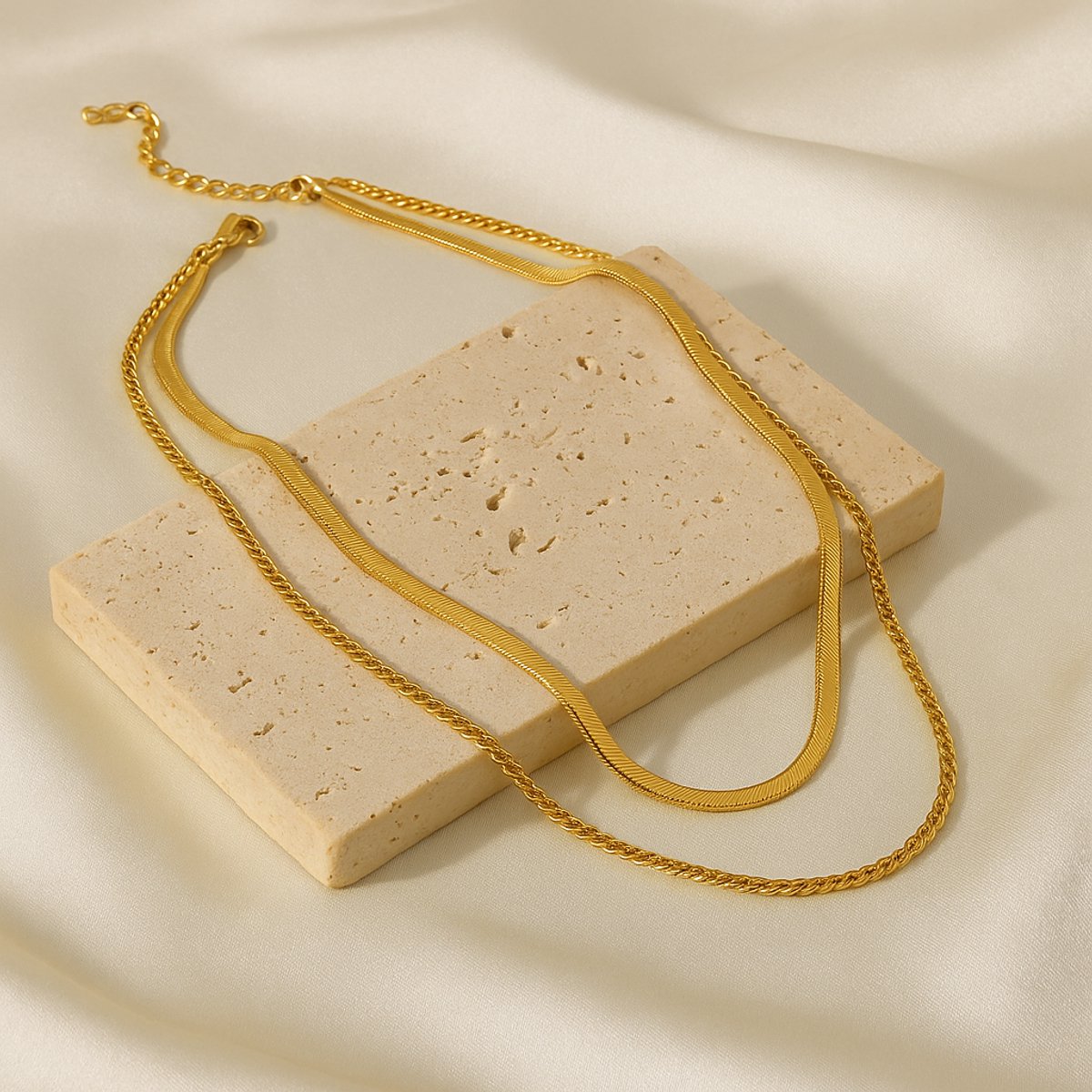

Which Jewelry Material Doesn't Tarnish? Complete Overview
Which jewelry material doesn't tarnish? Platinum, solid 18-karat gold, titanium and stainless steel tarnish the least. Stainless steel with a PVD colour layer keeps its gold tone much longer than ordinary gold plating. Silver turns black if you don't look after it, and gold-plated brass, copper and zinc alloy tarnish fastest. Below you'll find the ranking, what the terms on the label mean, and what to choose for each type of jewelry.

The short answer
From hardly tarnishes to tarnishes fast:
- Platinum and solid gold (18 karat): hardly tarnish, but they are expensive.
- Titanium and stainless steel: hardly tarnish; dullness is usually a film of lotion or soap.
- Stainless steel with PVD: a hard colour layer that wears much more slowly than ordinary gold plating.
- Gold filled and vermeil: a thicker gold layer that lasts a long time but can wear after years.
- Sterling silver: turns black without care, but can be polished back.
- Gold-plated brass, copper and zinc alloy: tarnish fastest once the plating wears off.
For jewelry you wear every day, stainless steel is the practical choice: affordable, waterproof and no polishing.
Why jewelry turns green, black or dull, and what to do once it has, is covered in why does my necklace tarnish? This guide helps you choose beforehand: which material, which label and which piece.
Ranked: which material tarnishes least?
From least to most tarnishing, with how much care each needs and whether it suits everyday wear:
| Material | Tarnishes? | Care | Everyday wear? |
|---|---|---|---|
| Platinum | Hardly | Polish now and then | Yes, but expensive |
| Solid gold, 18 karat | Hardly | Polish now and then | Yes, but expensive |
| Solid gold, 14 or 9 karat | Can dull slightly | Polish now and then | Yes |
| Titanium | Hardly | Rinse | Yes |
| Stainless steel, silver tone | Hardly | Rinse with mild soap | Yes |
| Stainless steel with PVD, gold tone | The colour layer wears very slowly | Rinse with mild soap | Yes |
| Gold filled | Wear on friction points after years | Soft cloth | Yes |
| Vermeil (gold-plated sterling silver) | Gold wears, the silver underneath darkens | Polish gently | With care |
| Sterling silver (925) | Turns black | Polish regularly | Yes, with care |
| Gold-plated brass or copper | Plating wears, green or dark underneath | Little you can do | Better not |
| Zinc alloy (fashion jewelry) | Dull and grey once the plating wears | Little you can do | Better not |
Titanium and stainless steel sit side by side on purpose: both hardly tarnish. Titanium is lighter and contains no nickel; stainless steel is easier to work and therefore available in many more designs. If you have sensitive skin, also read hypoallergenic jewelry explained.
What does the label say? How to read it
Labels and product pages often use terms that tell you a lot about how long a piece will stay beautiful. Here is what they mean:
| On the label | What it is | Does it tarnish? |
|---|---|---|
| Stainless steel, inox | Rust-resistant steel with chromium | Hardly |
| 304, 316L, surgical steel | Common grades of stainless steel | Hardly |
| Titanium steel | Usually a type of stainless steel, not pure titanium | Hardly |
| Titanium (grade 1, 2 or 23) | Pure titanium or a titanium alloy | Hardly |
| PVD, IP plated (ion plating) | A hard colour layer applied in a vacuum; IP is a form of PVD | Much more slowly than ordinary plating |
| Gold plated, 18K plated | A thin layer of gold over another metal | Depends on the metal underneath |
| Gold filled, 14K GF | A thick gold layer bonded to a core, often 5 percent of the weight | Not for a long time, but can wear after years |
| Vermeil | Sterling silver with a thicker gold layer | The silver underneath can darken |
| 925, sterling | Silver with 7.5 percent other metal, usually copper | Yes, it turns black |
| Rhodium plated | A shiny rhodium layer, often over silver or white gold | The layer wears over time |
| Alloy, fashion metal, zamak | Usually zinc alloy or brass | Yes, once the plating wears |
Two rules of thumb. The better the metal under a coating, the less it matters when that coating eventually wears. And if a label only says ‘alloy’ or ‘metal’ without further detail, chances are the piece will tarnish quickly.
Why does stainless steel with PVD tarnish more slowly?
Stainless steel hardly tarnishes thanks to the chromium in it. It forms an invisible, very thin layer of chromium oxide on the surface that protects the metal and repairs itself after a scratch. For a gold tone, a colour layer goes on top.
With ordinary gold plating, a piece hangs in a bath in which gold is deposited onto the metal. With PVD (physical vapour deposition), the colour layer is applied to the steel as a vapour in a vacuum chamber. That layer is thin too, but much harder and it bonds more strongly. So it wears more slowly, and where it does eventually wear, what appears is steel, which doesn't turn green or black itself. With plated brass or zinc, that is exactly the moment tarnishing begins.
A PVD layer isn't indestructible: abrasive cleaners, chlorine bleach and metal rubbing against metal remain the biggest culprits. How to clean each material is explained in how to clean jewelry by material.
Piece by piece: where does a colour layer wear fastest?
The material is one thing, how you wear a piece is another. A ring takes far more wear than a pair of studs. From most to least wear:
Rings: the most friction
Your hands grab everything, you wash them often and you rub cream into them. So a colour layer wears first on the inside and underside of a ring. If you wear a ring every day, silver-tone stainless steel is the most carefree: the colour is the steel itself, so there's no layer to wear off. If you go for gold tone, choose stainless steel with PVD and take it off for the dishes and cleaning.

Pictured
Vanja – silver-tone dome ring
Polished stainless steel with a wavy relief and no colour layer. It is open and adjustable, and suits every day: from your morning coffee to a dinner out.
View the Vanja →


Bracelets: desk, laptop and watch
A bracelet taps against your desk and rubs along your laptop or watch, and links rub against each other. For every day, choose a sturdy chain bracelet or bangle in stainless steel and preferably wear your watch on the other wrist. If you wear several bracelets at once, take them off for workouts so they rub against each other less.


Find more among our bracelets; how to combine them is explained in stacking bracelets.
Necklaces: sweat and perfume at your neck
A necklace has an easier time, but sweat, perfume and body lotion meet at your neck. The clasp and the back of a pendant take the most wear, and layered necklaces also rub against each other. So don't spray perfume on your neck while wearing a necklace, and let lotion soak in first.


How to layer necklaces without them tangling is explained in layering necklaces.
Earrings: least wear, with one exception
Earrings are rarely touched and wear the least. The exception: shampoo, hairspray and dry shampoo, which often land right on your earrings. So put your earrings in once your hair is done. With huggies and click hoops, the little hinge wears fastest; open and close them gently.

Pictured
Lexi – twisted hoops
Chunky twisted hoops in stainless steel with a gold-tone PVD layer. The twisted shape catches the light, and they look just as good with a sweater as with a dress.
View the Lexi →


Which material suits you?
There's no single best material; it depends on what matters to you:
- You never want to polishChoose stainless steel, silver tone or gold tone with PVD. Waterproof and fine for every day.
- You want something for lifeChoose solid 14 or 18 karat gold, or platinum. Expensive, but it hardly tarnishes.
- You have sensitive skinChoose titanium or stainless steel. Read more in hypoallergenic jewelry explained.
- You love real silverChoose sterling silver and accept the polishing, or choose silver-tone stainless steel for the same look without the upkeep.
How to keep any material beautiful for longer
Whatever you choose: jewelry goes on last and comes off first. Perfume and cream first, then your jewelry. Store pieces separately so they don't rub against each other, and silver preferably airtight. What you can and can't do in the shower, the sea and the pool is covered in jewelry you can wear in water.
Shipping and gift packaging
Order before 3 pm (CET) on a working day and we'll ship your jewelry the same day. The free-shipping threshold depends on your country; you'll find the details on our shipping page. Every piece arrives gift-ready, and when you order from our own webshop you always get a free gift bag. With higher order values you also get free gifts through our gift ladder (different ones every month).
Frequently asked questions about materials that don't tarnish
Which jewelry material doesn't tarnish?
Platinum, solid 18-karat gold, titanium and stainless steel tarnish the least. Stainless steel with a PVD colour layer keeps its gold tone much longer than ordinary gold plating. Silver turns black without care, and gold-plated brass, copper and zinc alloy tarnish fastest.
Which jewelry can you wear every day without it tarnishing?
Jewelry made of stainless steel or titanium. It can handle water and sweat and hardly tarnishes. Gold-tone stainless steel with a PVD layer wears much more slowly than ordinary plating. If it does look dull, it's usually a film of lotion or soap that washes off.
What is the difference between gold plating and PVD?
With gold plating, a thin layer of gold is applied to a metal in a bath, often to brass or zinc. With PVD, the colour layer is applied to the metal in a vacuum chamber. That layer is harder and bonds more strongly, so it wears much more slowly. On stainless steel, the metal underneath hardly tarnishes either.
Does gold filled jewelry tarnish?
Gold filled has a thick gold layer bonded to a brass or copper core. It lasts a long time, but can wear on friction points after years, after which the metal underneath can tarnish.
Does vermeil tarnish?
Vermeil is sterling silver with a thicker gold layer. As long as that layer is intact, it stays gold. Where it wears, silver shows through, and that can darken.
Does 14 karat gold tarnish?
Hardly. Solid 14-karat gold can develop a light haze over time because of the other metals in it; 9 karat does so faster. A soft polishing cloth removes it.
Is titanium better than stainless steel?
Both hardly tarnish. Titanium is lighter and contains no nickel, which is nice for very sensitive skin. Stainless steel is easier to work and therefore available in many more designs and fine details.
What does titanium steel mean?
Titanium steel is a trade name usually used for a type of stainless steel, not for pure titanium. It hardly tarnishes, just like other stainless steel.
What is the best material for a ring you always wear?
Silver-tone stainless steel: the colour is the steel itself, so there is no layer to wear off. If you want gold tone, choose stainless steel with a PVD layer and take your ring off for the dishes and cleaning.
Jewelry for every day
Discover Lundholm rings, bracelets and necklaces: premium stainless steel, waterproof, hypoallergenic and always gift-ready.
Share
